


How Thermal Imaging Helps Identify Hidden Moisture During Home Inspections

What buyers, sellers, and homeowners should know about infrared imaging during a home inspection
Most homeowners expect water damage to be obvious. They imagine stained ceilings, peeling paint, warped flooring, or visible mold growth.
In reality, moisture intrusion often develops long before visible signs appear.
A wall, ceiling, or floor can look perfectly normal while elevated moisture levels remain hidden behind finished surfaces. That is one reason many home inspectors use thermal imaging as an additional inspection tool.
At Smart Start Home Inspection, PLLC, I may use thermal imaging equipment when conditions are appropriate to help identify temperature anomalies that could indicate moisture intrusion, air leakage, insulation deficiencies, HVAC performance concerns, and other conditions that may not be readily visible during a standard visual inspection.
Is Thermal Imaging Required During a Texas Home Inspection?
No.
The Texas Real Estate Commission (TREC) Standards of Practice do not require inspectors to use thermal imaging equipment during a home inspection.
A Texas home inspection can be performed without thermal imaging.
However, thermal imaging can provide additional information by helping identify temperature differences that may warrant further evaluation.
It is important to understand that thermal imaging does not see through walls and does not directly detect moisture. Instead, it identifies temperature anomalies that may be associated with moisture intrusion, missing insulation, air leakage, HVAC deficiencies, or other conditions.
Why Hidden Moisture Matters
Moisture intrusion can contribute to:
Drywall damage
Wood deterioration
Flooring damage
Insulation degradation
Mold-friendly conditions
Costly repairs
The earlier moisture-related concerns are identified, the easier they are often to address.
Real Example: Hidden Moisture Behind a Clean Ceiling

In this example, the ceiling showed little or no visible indication of a moisture problem.
Thermal imaging identified a cool temperature anomaly that warranted additional evaluation.
After further investigation using a moisture meter, elevated moisture levels were confirmed.
Without thermal imaging, this condition may have been much more difficult to identify during a visual inspection alone.
Real Example: Moisture Intrusion Below a Window

In this case, the wall beneath a window showed no obvious visible staining or damage.
Thermal imaging revealed a distinct thermal anomaly below the window.
Interestingly, a similar condition was observed in another home with the same floor plan in the same neighborhood. Both homes were built by the same builder, suggesting the condition may have been related to a common construction detail associated with that floor plan.
Conditions such as these demonstrate how moisture-related concerns can exist before visible symptoms appear on interior surfaces.
Why Thermal Imaging and Moisture Meters Work Together

Thermal imaging identifies temperature differences that may be associated with moisture, insulation deficiencies, air leakage, HVAC performance concerns, or other building conditions. Because temperature anomalies can have multiple causes, additional testing is often necessary.
In this example, thermal imaging revealed a cool anomaly within the ceiling. Moisture meter testing was then used to investigate the condition further and confirmed elevated moisture levels in the affected area.
This process helps inspectors avoid making assumptions and provides clients with better information about the condition being observed.
Thermal Imaging Can Help Define the Extent of a Moisture Condition
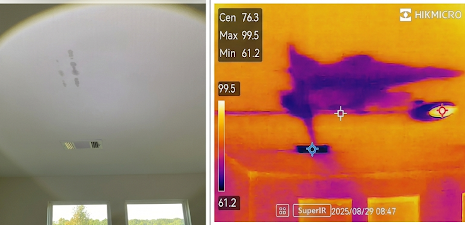
A common misconception is that visible staining tells the entire story.
In some cases, the visible evidence of moisture intrusion may represent only a portion of the affected area. Thermal imaging can sometimes help inspectors better understand the extent of a temperature anomaly and identify areas that may warrant additional evaluation.
In this example, a relatively small amount of visible staining was present on the ceiling. Thermal imaging revealed a much larger area exhibiting an unusual temperature pattern, suggesting that the condition extended beyond what was readily visible.
This does not mean thermal imaging can determine the full extent of the damage or identify every affected area. However, it can provide valuable information that may not be immediately apparent during a visual inspection alone.
What Thermal Imaging Can and Cannot Do
Thermal Imaging May Help Identify:
Hidden moisture conditions
Roof leak indicators
Plumbing leak indicators
HVAC condensation concerns
Missing insulation
Air leakage conditions
HVAC performance issues
Building envelope deficiencies
Thermal Imaging Cannot:
See through walls
Guarantee that moisture is present
Determine the exact source of a leak
Predict future moisture intrusion
Replace invasive testing
Guarantee that no hidden defects exist
Thermal Imaging Can Reveal More Than Hidden Moisture
Thermal imaging is a tool that helps identify areas that may deserve additional evaluation.
Hidden moisture is one of the most valuable applications of thermal imaging, but it is far from the only one. During future inspections and blog articles, we'll take a closer look at how thermal imaging can help identify missing insulation, air leakage, damaged ductwork, and HVAC performance concerns that may affect comfort and energy efficiency.
These examples further demonstrate why thermal imaging has become such a valuable tool during modern home inspections.
Why Local Experience Matters in the Houston Area
Homes throughout Sugar Land, Katy, Richmond, Rosenberg, Fulshear, Sienna, Missouri City, and surrounding communities face conditions that make moisture management especially important.
These include:
High humidity
Wind-driven rain
Intense summer heat
HVAC condensation
Heavy rainfall events
Roof leaks
Window and door water intrusion
Understanding how southeast Texas homes respond to these conditions helps provide valuable context when evaluating thermal anomalies and moisture-related concerns.
Schedule a Home Inspection in Fort Bend County

If you are buying, selling, or maintaining a home in Fort Bend County or the greater Houston metro area, thermal imaging may help identify hidden conditions that are not readily visible during a standard visual inspection.
Smart Start Home Inspection, PLLC provides professional home inspections built around the TREC Standards of Practice and may utilize thermal imaging, drone-assisted roof observations, ZIPLEVEL® elevation assessments, and other tools when appropriate.
Contact Smart Start Home Inspection, PLLC today to schedule your inspection and learn how thermal imaging may provide additional information about your property's visible condition.
Frequently Asked Questions About Thermal Imaging
Is thermal imaging included in a home inspection?
Thermal imaging is not required under the TREC Standards of Practice. Some inspectors choose to use thermal imaging as an additional inspection tool when conditions are appropriate.
Can thermal imaging detect moisture?
Thermal imaging identifies temperature anomalies that may be associated with moisture. Additional testing is often needed to verify whether elevated moisture levels are present.
Can thermal imaging see through walls?
No. Thermal imaging detects surface temperature differences and does not see through walls.
Can thermal imaging find leaks?
Thermal imaging may help identify temperature anomalies associated with moisture intrusion, but additional investigation is often necessary to determine the source of a leak.
What areas does Smart Start Home Inspection serve?
Smart Start Home Inspection serves Fort Bend, Harris, Brazoria, and Galveston counties, including Sugar Land, Richmond, Missouri City, Sienna, Fulshear, Katy, Rosenberg, Fresno, Arcola, Manvel, Rosharon, Iowa Colony, Pecan Grove, Aliana, First Colony, Telfair, and surrounding communities.


Comments